



FreeSense Fleet is self-hosted: no cloud, no account, all yours
Fleet is not a cloud service. The controller is a FreeSense system you run, your data stays on it, and nothing is sent to FreeSense.
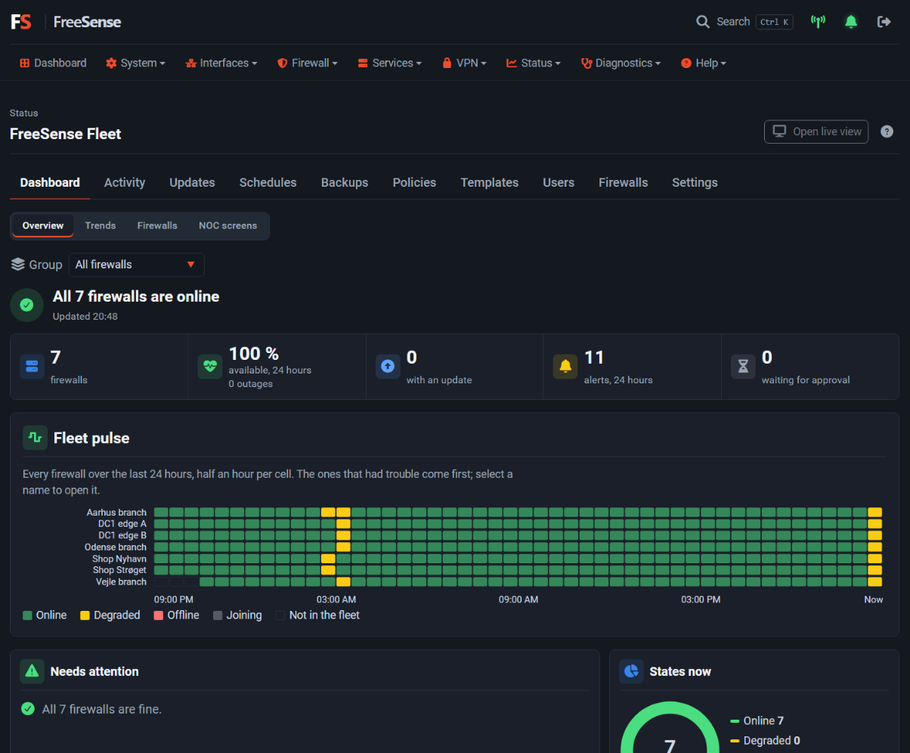
Central management usually means a vendor's cloud: you create an account, your firewalls call a service you do not run, and your fleet is only as private as that service. FreeSense Fleet works the other way round. It is self-hosted by design, and it is not a cloud service.
What that means
- No Fleet cloud and no account. There is no FreeSense-hosted service to sign up for, and no subscription.
- Your data stays on your controller. The inventory, history, alerts, backups, policies and keys live on the controller. Removing the package does not delete the fleet.
- Nothing is sent to FreeSense. Fleet makes no connection to FreeSense servers. The invitation points at your controller, and each firewall pins its certificate.
- Encrypted and authenticated. Firewalls reach the controller over the Fleet WireGuard tunnel, a tailnet, or directly. A firewall joins with your invitation and a 6-digit approval code that you compare on both screens.
- Third parties only if you choose them. Tailscale is one way to connect, and alerts can go to email, a webhook, Slack or Teams, Telegram, ntfy or Gotify. Fleet works without any of them.
Run the controller wherever you want
The controller is an ordinary FreeSense system, so you decide where it lives: on your own network, on your own server, or inside a tailnet. You can also deploy it from a FreeSense cloud image on a server or cloud account that you own, give it a public address, and manage your fleet from that secure site. It is still your server and your data, and the project runs nothing. Firewalls open the connection to the controller, so only the controller has to be reachable.
How it compares
The Compare page now sets Fleet next to the central managers of pfSense Plus, OPNsense, Sophos and UniFi, using only what their own documentation says.
Status
Fleet is part of the Development line (FreeSense 1.2). It is experimental and not in Stable 1.1, so do not manage production firewalls with it yet. Read the documentation and the status page for what was tested.